

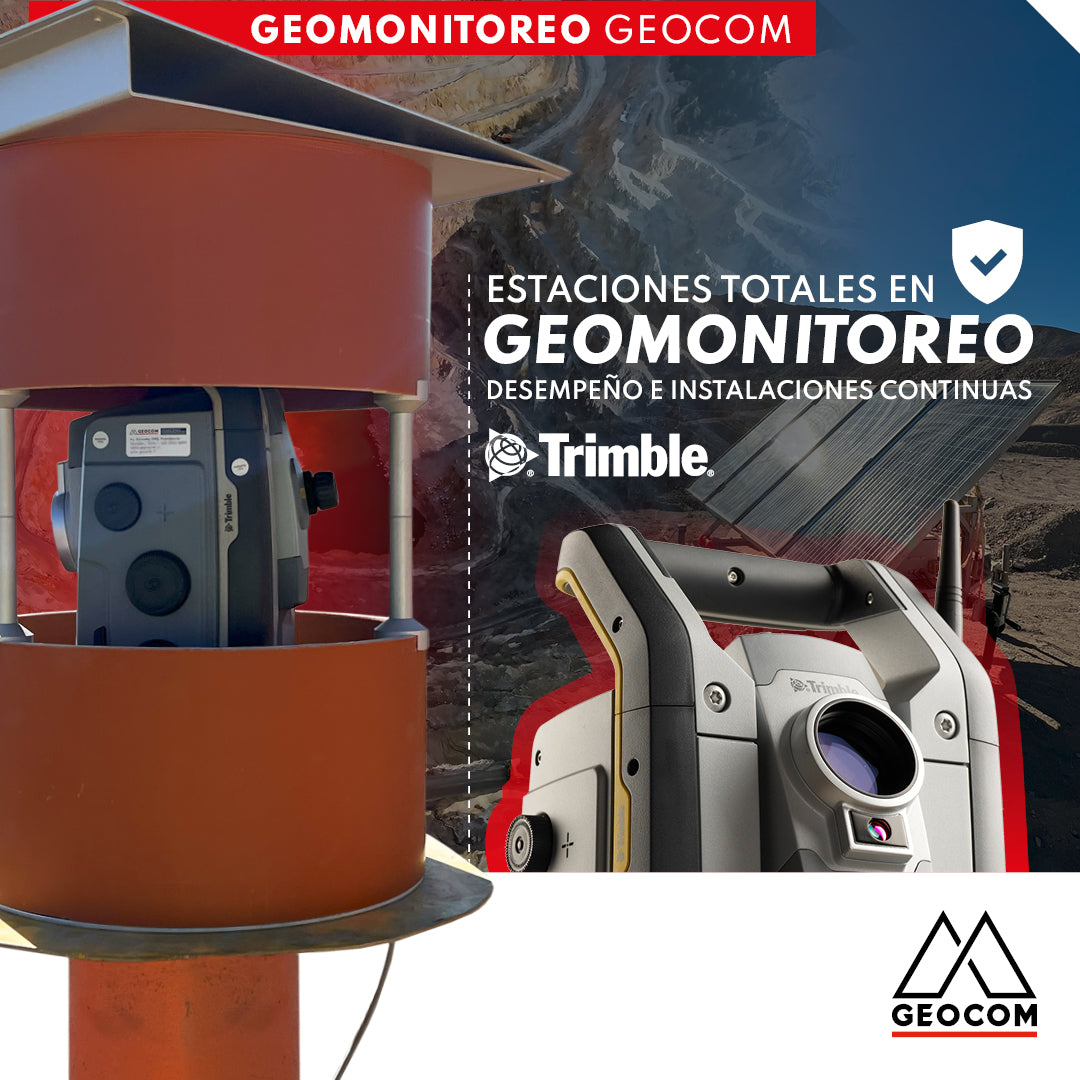

TOTAL STATIONS IN GEOMONITORING: Performance and continuous installations
Geomonitoring Geocom
One of the most frequent questions when starting to work with total stations is about their performance in “adverse” conditions, commonly related to temperature, humidity, and dust. The answer to this question is found in the datasheet (technical specifications) of each instrument:
⨮ Storage temperature is the temperature range in which the total station can be stored while not turned on.
⨮ IP65: Ingress protection for dust and water (Table 1)
⨮ Humidity: Hermetic condensation protection
|
IP Rating |
Protection against solids |
Protection against water |
|
IP00 |
No protection |
No protection |
|
IP20 |
Protected against objects >12.5mm |
No protection |
|
IP44 |
Protected against objects >1mm |
Splashing water |
|
IP54 |
Protected against limited dust ingress |
Splashing water |
|
IP65 |
Dustproof |
Water jets |
Based on this information, the use of total stations in “adverse” environments can be carried out without compromising the efficiency and quality of observations. In this case, the relationship of these characteristics with GEOMONITORING projects is key to their success.
Geomonitoring, installations, and total stations
The use of total stations for geomonitoring structures requires considering prolonged observation sessions, which must be carried out in robust installations to ensure stability during the GEOMONITORING process. Here, the robustness of the installations must be intrinsically linked to the flexibility needed in mining environments, where changing dynamics frequently require dismantling and reinstalling the total station. This combination of solidity and adaptability is crucial to ensure precise and consistent measurements in different scenarios.
Thus, to achieve these robust and flexible installations, GEOCOM has developed an installation concept based on the ability of Trimble S-series total stations to perform in “adverse” conditions (temperature, humidity, and dust). In this sense, the central axis of this proposal is the monitoring dome:

|
The dome is designed for use with Trimble S series instruments. The dome measures 500 mm at its highest point and 370 mm wide, including the upper rectangular section. The central section for the total station's line of sight is 150 mm high. This can be modified depending on the needs of each project. |
Once the total station is installed, it is possible to carry out monitoring rounds with a robust and flexible approach without the need for additional infrastructure, such as sheds or larger structures. The image below shows a Trimble S9 total station in a mining environment during its installation and Geomonitoring process.

Maintenance recommendations
Considering that the total station will be operating for extended periods under different environments, it is suggested to use compressed air, from a small compressor, to remove accumulated dust, especially on the instrument's movable parts. This method is effective for cleaning the lens and the rest of the equipment. For minor residues that persist, it is advisable to use a soft-bristle brush. Finally, for a deep cleaning, it is recommended to apply isopropyl alcohol with a specialized cloth for lenses or glass surfaces.
Conclusions: Are shelters necessary?
The use of domes for Geomonitoring projects favors the necessary flexibility in mining environments under a robust installation. With maintenance procedures similar to those employed in traditional monitoring shelters, the use of domes becomes an efficient solution for the development of this type of project.
Compartir:
Point Cloud Georeferencing | Trimble R12i
RIEGL VZi-Series: Kinematic Measurements with Terrestrial LiDAR Scanners (TLS)