

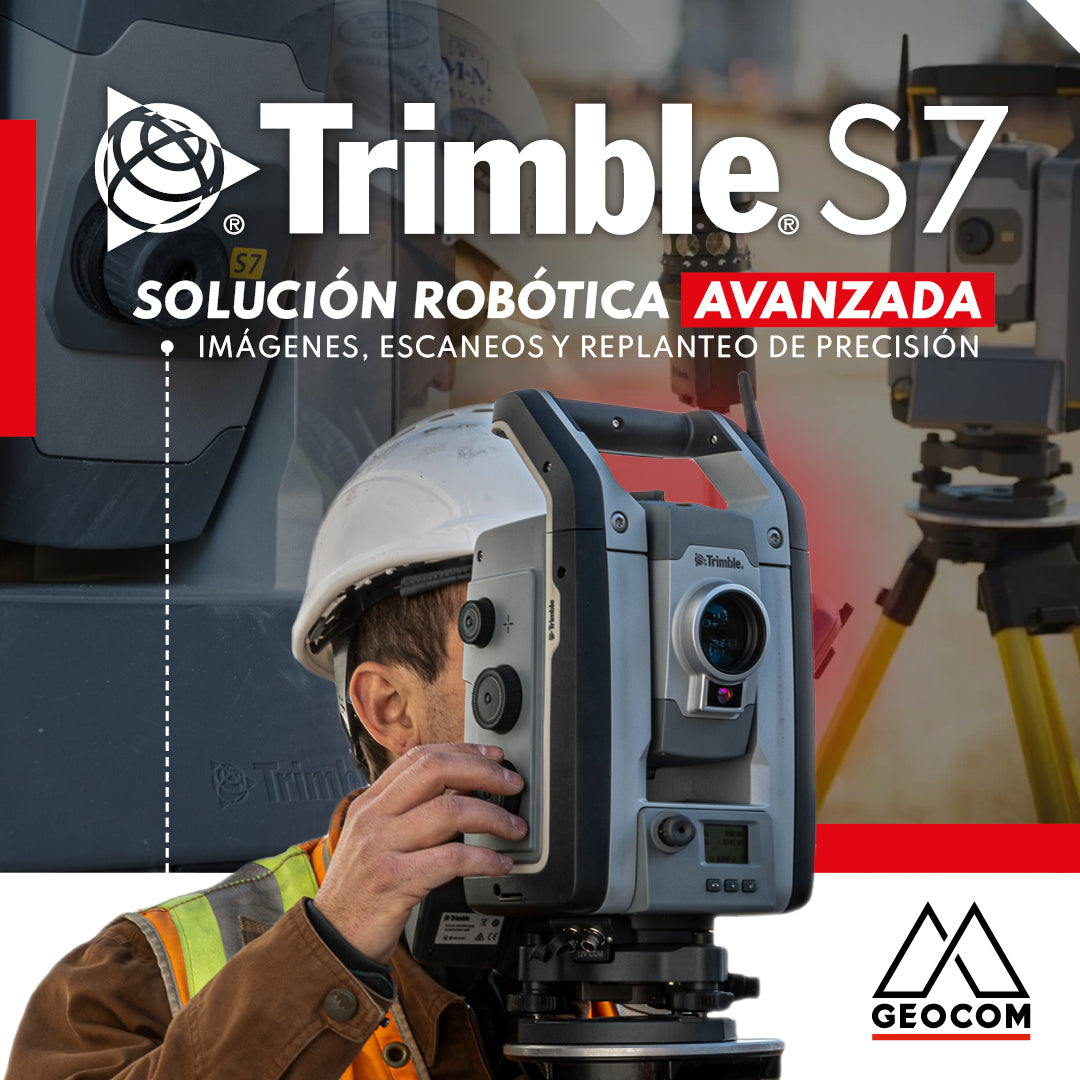

Trimble S7: Advanced robotic solution combining images, scans, and precision staking
Trimble S7, in the field of robotic total stations, allows for total remote control thanks to its built-in “Trimble Vision™” camera. This functionality offered by the S7 to incorporate images and video into your surveying work, when combined with SureScan, provides highly representative evidence when collecting data. Furthermore, Finelock offers a better perspective for monitoring and precision applications in conjunction with DR Plus technology.
⨭ROBOTIC SYSTEM:
Whether a system is robotic depends mainly on its remote control capability. In the case of the robotic system, the communication medium between the controller and the total station is a 2.4 GHz radio link, which allows for a long range.

In various construction-related tasks, the long range of the Empower radio module incorporated into Trimble TSC5 and TSC7 controllers allows communication with the total station within a range that opens up a variety of possibilities. This system capability gives the professional the freedom to move around the work area, positioning the equipment in a convenient location for remote surveying or staking.

One application of the robotic mode between Trimble S7 and its controllers is topographic surveys involving only one person. Using the same methodology, staking can be done quickly and easily compared to conventional methods.

⨭ TRIMBLE VISION™
Trimble VISION technology incorporates a calibrated camera into the instrument, allowing it to transmit live video via a radio connection. This technology can be used to take snapshots for documentation purposes, frame the area to be scanned, or provide the user with a real-time view from the instrument on the controller screen. It offers two areas of use: one is to extract geometric features from represented objects through photogrammetric techniques such as epipolar pairs and to integrate compelling documentary evidence through photographs to complement topographic surveys. Additionally, photographs serve as a complementary element in examinations and scans. On the other hand, in robotic or remote operation, the camera is vital for providing unambiguous orientation to the prism desired for locking when performing topographic representations or precise observation.

⨭ AUTOLOCK AND FINELOCK
Autolock is an automatic aiming system developed by Trimble that allows tracking a prism by identifying its position and simultaneously following it in motion. The primary use of Autolock is for moving applications where 360° prisms are used; however, for maximum precision applications, such as robotic staking, the use of precision prisms or mini-prisms allows for the highest possible accuracy with the instrument. The total station can follow the prism wherever it goes, whether on a pole, precise staking accessory, or directly mounted on a vehicle whose trajectory is to be determined.
Finelock is another automatic aiming system with its main focus on static targets and applications where extremely high precision in coordinate determination is required. Finelock features an extremely efficient prism detector for long distances and for discriminating elements. FineLock has the capacity to lock onto prisms up to 700 m, while LongRange Finelock does so for targets located up to 2500 m.

⨭ SCANNING
Trimble S7 and S9 total stations with a camera (VISION™ technology) can be equipped with an optional surface scanning function. This function allows the instrument to measure the shape of a surface for surface modeling, volume calculations, etc.
Trimble SureScan™ technology optimizes the point grid to improve scanning performance.
Trimble S7's SureScan allows for surface scanning, maintaining distance parameters according to capture needs, making it an excellent application of automatic movement via MagDrive. The scanning speed is 15 points per second.


⨭ INCORPORATING 3D MODELS FOR BIM OPERATION
Today, BIM is the standard for the engineering and construction of any project, generating a variety of benefits associated with productivity. The result of these three-dimensional designs is currently the necessary source of information for their materialization, which is directly associated with field topographic activities. The IFC format (or its similar TrimBIM according to Trimble) is widely used in the engineering industry. IFC is developed by BuildingSmart International, and its main objective is to facilitate interoperability within the engineering and construction sector based on the foundations of BIM: topography is certainly not excluded from this philosophy.
For its part, Trimble has developed a collaborative platform called Trimble Connect, which allows managing and collaborating on geospatial information, such as project data and/or field work, in a digital environment.

This is where Trimble Access interacts with Trimble Connect, enabling the connection between office and field. Once the work is done, the result of the task, whether it's a survey or staking, is synchronized with Trimble Connect.
A direct application of using 3D models under Trimble Access is their staking in the most diverse possibilities. Select points for specific staking, lines to extend alignments, and 3D surfaces to control according to their normal.
⨭ INCORPORATING 3D MODELS FOR BIM OPERATION
The robotic staking of the Trimble S7 is a differentiating factor, all supported by Magdrive technology, since the movement of a Trimble S-series total station is based on this technology. Magnetic attraction and repulsion can be induced through an electric current by means of a coil, which, in practical terms, means levitation. This results in a friction-free, lighter, and smaller servo-assisted system, without noise or gears, giving the instrument a maximum speed of 115° per second. Magdrive plus Autolock and Trimble Access make up the robotic LT system, allowing the professional freedom in the work area for precise and safe marking.
The use of accessories for staking fine elements such as axes, anchor bolts or other required elements, significantly helps with marking, control and surveying.


⨭ CYCLE MEASUREMENT
Cycle measurement, more commonly known as angular reiteration, is undoubtedly one of the most widely used techniques in geodesy. Today, it is possible to perform these measurements with robotic total stations in an automated manner, using the Autolock automatic prism lock system. The observation time is minimal, allowing for the capture of redundant data that enables the determination of an element's position with extremely high precision.
Applying this methodology to high-precision staking allows verifying whether the mark made is subject to modification or not, relative to the theoretical position.
Another obvious application of this technique is the precise observation of angles and distances for geodetic networks/traverses. Finally, these observations are imported into Trimble Business Center for corresponding analysis and adjustment.
The S-series total stations are equipped with 2 angle sensors spaced 180° apart for measuring horizontal and vertical directions. Averaging both readings eliminates the influence of circle eccentricity relative to the vertical axis. Additionally, each angular observation considers the horizontal collimation error, the index error for vertical angles, and the trunnion axis error, values that have been incorporated into the total station after its calibration. The S-series provides total stations with:
1”: High-precision applications.
2”, 3” and 5”: Conventional surveying applications.


⨭ DIRECT REFLEX (DR)
The electronic distance measurement (EDM) of Trimble S-series total stations consists of a unit for laser pulse distance measurement that determines distances by precisely measuring the time of flight of the transmitted light pulse. The distance unit generates shorter laser pulses, which are transmitted from the telescope to the target. The pulses are reflected from the target surface and returned to the instrument where the time difference between the transmitted and received pulses is determined: the unit uses this time difference to calculate the distance to the target, a technique known as "time of flight." Specifically, the Trimble S7 has a disto called DR Plus, which provides an accuracy of 1 mm + 2 ppm (according to ISO standard) when measuring to prisms.
For its part, Direct Reflex (DR) refers to the prism-free measurement capability, where the expected accuracy is 2 mm + 2 ppm and the expected range, according to the reflectivity of the surface, is 550m to 1200m for DR Plus.

⨭ INTEGRATED SURVEYING
Integrated surveying is a unique feature of Trimble Access, whose license allows communication with both GNSS and S-series total stations. One of the possibilities is the orientation of the total station based on GNSS RTK observations. The technique is a resection or inverse intersection, where the GNSS provides the coordinate of the point to be used, while the Trimble S7 measures to the prism with Autolock. This technique can be carried out with all S and SX series total stations.

The immediate application of integrated surveying is the convenient setup of the total station referencing a coordinate system that is also linked to GNSS. This achieves agility by successfully combining GNSS observations with the total station itself.


Compartir:
Modernized Approaches for GNSS Baseline Processing in Trimble Business Center
Trimble Reality Capture | Capture, analyze and collaborate