

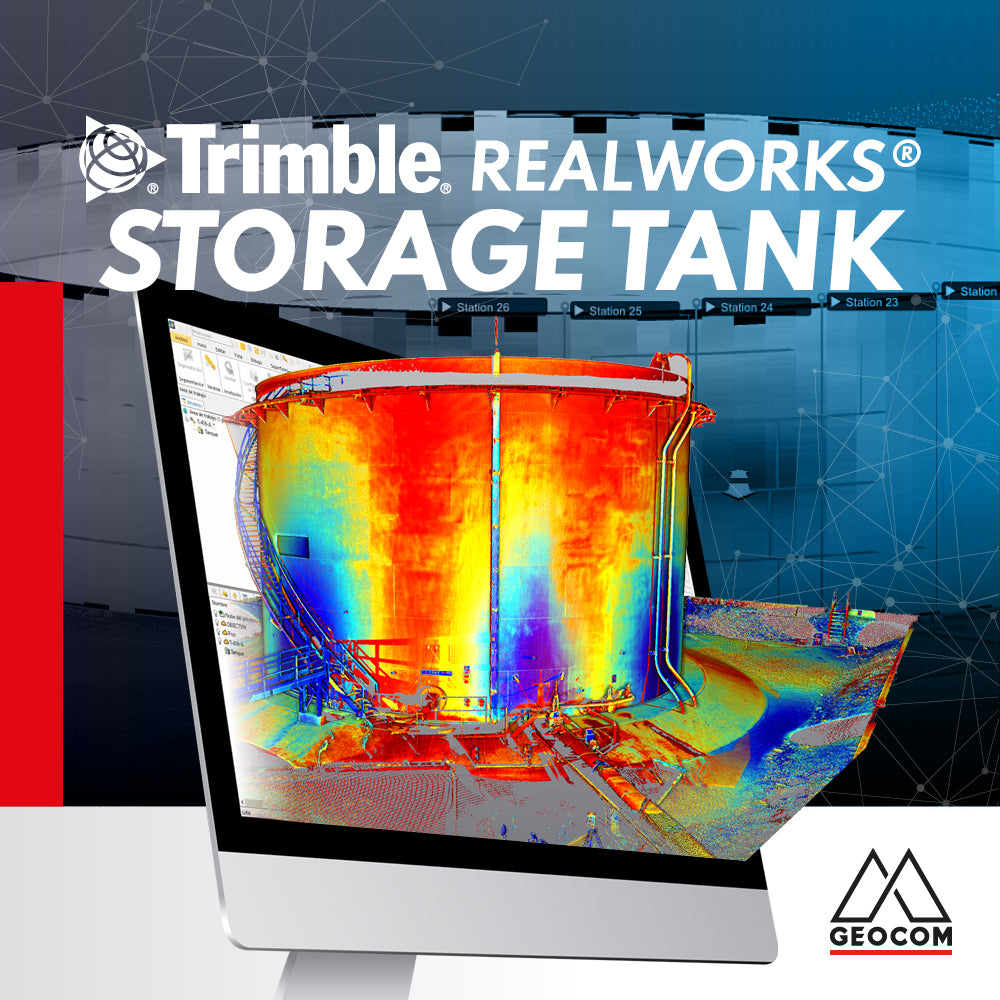

Geometric analysis of storage tank deformations is critical for the safety and stability of this type of structure. To perform this type of inspection, a series of measurements are necessary, from which the geometric conditions of the tank are defined.
Currently, the most common operation for performing these geometric captures is the use of topographic equipment, specifically Total Stations, surveying different sections of the tank to define its geometry.
In this sense, Laser Scanner technology is a great contribution in terms of obtaining information in the field, optimizing capture processes, and improving data accuracy. From this information, called LIDAR, valuable three-dimensional information (point cloud) is obtained, which allows for multiple geometric and dimensional analyses, including verticality and settlement analyses, with the objective of:
- Knowing the physical condition of the Tank.
- Monitoring the tank's condition over time.
- Obtaining environmental information, providing a solid database for generating engineering projects.
- Generating As-Built plans.

Fig 1. LIDAR capture, storage tank.
To handle LiDAR information, specialized software like Trimble RealWorks is necessary. This advanced software allows managing and analyzing LIDAR information and incorporates the Storage Tank module, which features specialized tools for geometric analysis of tanks based on API 653 standards. This makes it possible to perform verticality and roundness analyses of the shell, as well as analyze the tank floor if measurements were taken from inside.
Tank Classification
The Trimble Realworks Storage Tank Module, using its specialized tools, first allows automatic classification of the point cloud, separating tank components into different layers, from which we can generate corresponding analyses of the shell, bottom, etc.

Fig 2. Automatic point cloud classification
Tank Inspection
The analysis of the shell's verticality and circumference is a critical aspect of tank operation. Several standards define and regulate this type of analysis and inspection. Trimble Realworks Storage Tank Module automates the inspection process for storage tanks, incorporating processes for generating reports related to shell verticality and roundness analysis, based on API 653. It incorporates the tolerances of this standard, which facilitates the analysis of this type of information.
Verticality Analysis
In this process, vertical sections are calculated, the number of which is related to the tank's diameter and is regulated by API 653. From these sections, a verticality analysis is performed on opposite sections of the tank.
The analysis is carried out by comparing the theoretical vertical section with the point cloud in that same section, which must be within tolerance values.
Shell Roundness Analysis
This process calculates deviations in the shell's curvature in horizontal sections of the tank shell. These sections are made at the weld sections of each ring, and additionally, a sample is taken above and below the weld.
The analysis involves comparing the theoretical horizontal section with the point cloud, which must be within tolerance according to the standard.


Fig 3. Shell Analysis
Bottom Analysis
By performing an exhaustive analysis of the tank bottom, parameters are obtained to quantify possible tank settlements. Trimble RealWorks Storage Tank incorporates tools for analyzing this type of information from the point cloud captured inside the tank.
For this procedure, in the same locations where the analysis sections were generated, this information is projected onto the tank floor (if LIDAR information was captured inside the tank), where radial samples are taken in different sectors of the tank bottom. A comparison is made between the point cloud and the theoretical bottom design projection, which must be within the standard tolerance.

Fig 4. Shell Analysis
Reports and Deformation Analysis
Trimble RealWorks Storage Tank automates the generation of results reports, providing detailed supplementary information regarding compliance with established tolerances based on the corresponding standard.


Fig 5. Shell Analysis

Fig 6. Local deformation analysis
Compartir:
A comparison between Phantom 4 RTK and Zenmuse L1 in wooded areas
Trimble R12i Experience | Case 1