


128 Hz is an applied engineering and geophysics company, specializing in advanced subsurface characterization using non-invasive, high-precision methodologies. Their work integrates science, technology, and innovation to support decision-making in mining, infrastructure, and environmental projects, standing out for their technical rigor and the practical application of scientifically developed solutions. Currently, they are conducting geophysical studies applied to soil characterization through active seismic profiles and electrical resistivity tomography (ERT) profiles.
In this type of study, precise control of the horizontal and vertical position of each measurement point is essential as it directly impacts the quality of the geophysical models and their correct interpretation. For this experience, centimeter-level accuracy was required, along with a system that was fast, robust, and easy to operate in a mining environment.
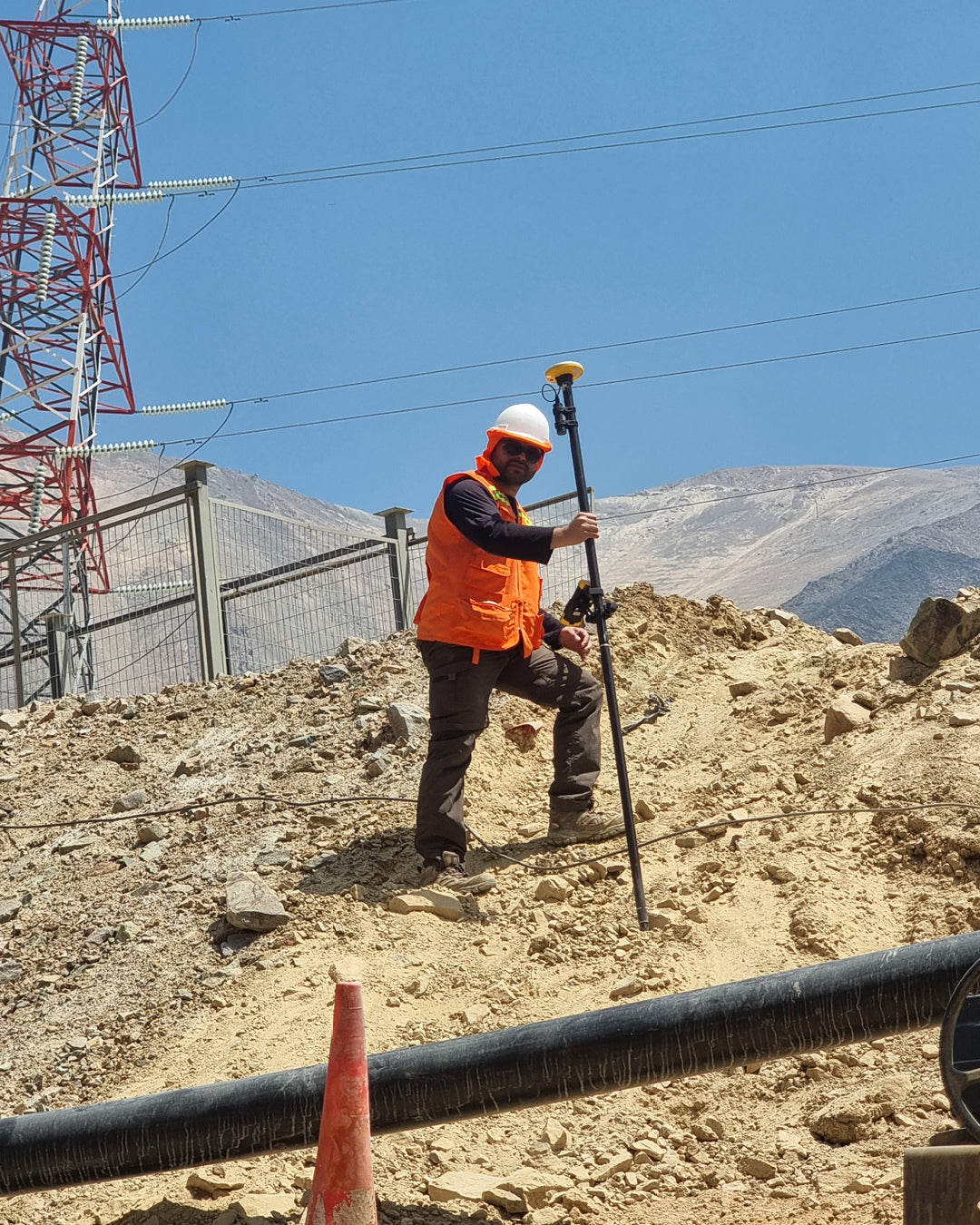
The GNSS receiver selected for the development of this project was the Trimble DA2 in conjunction with Trimble Access, to determine three-dimensional positions in support of the geophysical campaign.
In the words of 128 Hz personnel, they point out the following: "From an operational point of view, one of the most relevant aspects was the ease of use of the system." They state that the equipment is lightweight, simple to handle, allowing for high-precision positioning solutions in very short times thanks to the Trimble RTX PPP technique, which is key in field campaigns where time is often limited.
"In more shallow exploration geophysics (first tens of meters of soil), both in seismic and ERT, sensors – geophones or electrodes – are usually arranged at regular intervals, typically every 2 meters along a profile. This means surveying a significant number of points: for example, in a 60 m long profile, nearly 30 individual points must be positioned. In this scenario, the speed of the GNSS survey, without sacrificing precision, makes a significant operational difference," comment the professionals at 128 Hz.
"Using the Trimble DA2, we were able to survey entire profiles, recording approximately one point per minute, maintaining sufficient precision for the study's requirements. This allowed us to complete all field planning within the scheduled times, without bottlenecks associated with positioning," highlight 128 Hz.


Field performance and technical support
Trimble DA2 shows excellent field performance, even in a demanding environment like mining, due to its simplicity and durability. The reception of Trimble RTX corrections quickly achieves centimeter-level accuracy, without the need to install or operate a proprietary base station, which significantly simplifies logistics in campaigns of this type. In addition, the system supports the use of SIRGAS-Chile 2025 in conjunction with the determination of local coordinates using a local calibration, if necessary.
Another important point relates to the support provided by GEOCOM. 128 Hz highlights that the initial training allowed them to quickly start operating the system. During field work, the need for a system update arose, which was promptly resolved after contacting the GEOCOM support team, allowing measurements to continue without setbacks, according to the Geophysics firm.

Overall evaluation
From 128 Hz's experience, the use of GNSS receivers like the Trimble DA2 is highly recommended for a wide range of geophysical applications, particularly in seismic and electrical methods.
Key highlights include:
- Speed in obtaining precise solutions
- Ease of use in the field
- Elimination of the need for a base station
- Good technical support for eventual contingencies
As a practical consideration, it is important to note that some configurations require an internet connection at the start, which must be properly planned if working in very remote areas. Aside from that aspect, system operation is straightforward and robust.
Our thanks to 128Hz for this experience. More information about their services can be found at: https://128hz.cl/

Compartir:
Airborne GPR: How to See Underground with Drones and SPH Engineering
Free Mining Workshop Series 2026