

Ionospheric scintillation is a phenomenon where the GNSS signal rapidly varies in intensity and phase, as if it were "blinking." This can cause a GPS receiver to temporarily lose the signal from one or more satellites. Unlike other errors, scintillation cannot be easily corrected, even with dual-frequency signals. Scintillation generation is closely related to solar activity: its radiation and electromagnetic activity.

The phenomenon, concerning GNSS scintillation, causes high-precision receivers to lose positioning quality, mainly at night. This has been happening increasingly since 2022, with a peak in 2025, and will continue to affect until 2028. The affected months are from September to April, around midnight.
During the last three solar cycle maxima, GNSS users have experienced problems with RTK positioning. Each cycle has resulted in focused research and development to improve receiver tracking and processing algorithms. With the number of GNSS users doubling every cycle, significant efforts have been made to ensure the technology performs optimally to minimize disruptions during future cycles.
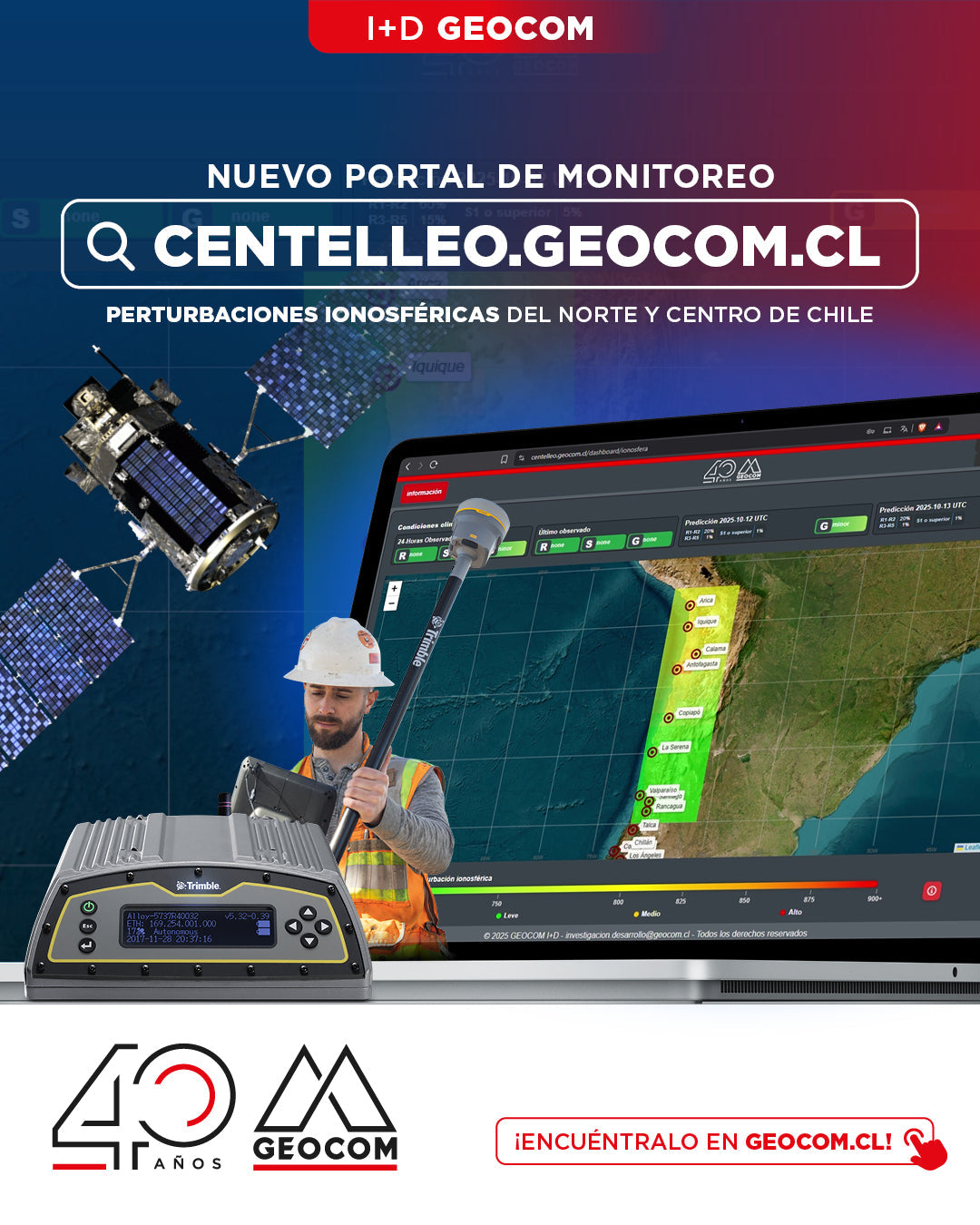
New monitoring portal https://centelleo.geocom.cl
GEOCOM, along with Trimble's development team, has taken further steps to ensure GNSS accuracy and availability for its customers through the development and implementation of Trimble IonoGuard mitigation technology. This mitigation technology, in operation worldwide, has already shown significant improvements in positioning performance during periods of high ionospheric activity.
In line with this, GEOCOM has developed a monitoring portal, which uses a heat map to visualize real-time tracking of ionospheric disturbances in northern and central Chile.

Compartir:
XGRIDS PortalCam: The First True 3D Space Camera
GEOCOM 2026 Calendar Contest - Participate!